
How a Mid-Tier Enterprise SaaS Provider Automates Cloud Support Triage
Mid-tier SaaS automates cloud support triage with a 5-agent workflow, boosting ticket validation, routing, and SLA compliance in enterprise cloud support.

The Ticket Triage Triangle That Slowed Cloud Support
Cloud support teams face a brutal bottleneck few talk about: the volume and complexity of incoming tickets overwhelm the system, both because of sheer numbers and due to three specific pitfalls we call the "Ticket Triage Triangle." Completeness breaks down as incoming tickets miss critical fields. Handoffs scramble because routing to Level 2 or 3 happens too slowly or inaccurately. Eventing gaps leave cloud operations blind to real-time updates. This costs precious minutes on every ticket and disrupts SLA adherence.
For a mid-tier global enterprise SaaS provider processing 15,000+ alert tickets annually, these issues were urgent. First response times hovered around 20 minutes, close to the 45-minute contract SLA, but tight given ticket volumes projected to hit 20,000 per year soon. The team faced mounting manual triage workloads, inconsistent ticket quality, and slow communication.
Mid-Tier SaaS Provider’s Pain Points Expose Industry-Wide Gaps
This wasn’t isolated. Across cloud software companies, similar challenges cripple support efficiency. Industry data shows 30-50% delays in incident resolution due to incomplete tickets. Traditional automation,rule-based engines, rigid RPA bots, and outsourcing,fails because it can't manage complexity or evolving SOPs. These approaches break when ticket formats change, lack iterative validation, or add handoff delays.
Cloud SaaS revenue is surging toward $750 billion by 2033, and regulations demand tighter SLA compliance and transparency. Fast, adaptive, scalable support automation is essential.
Five Agents Unclog Cloud Support at Scale
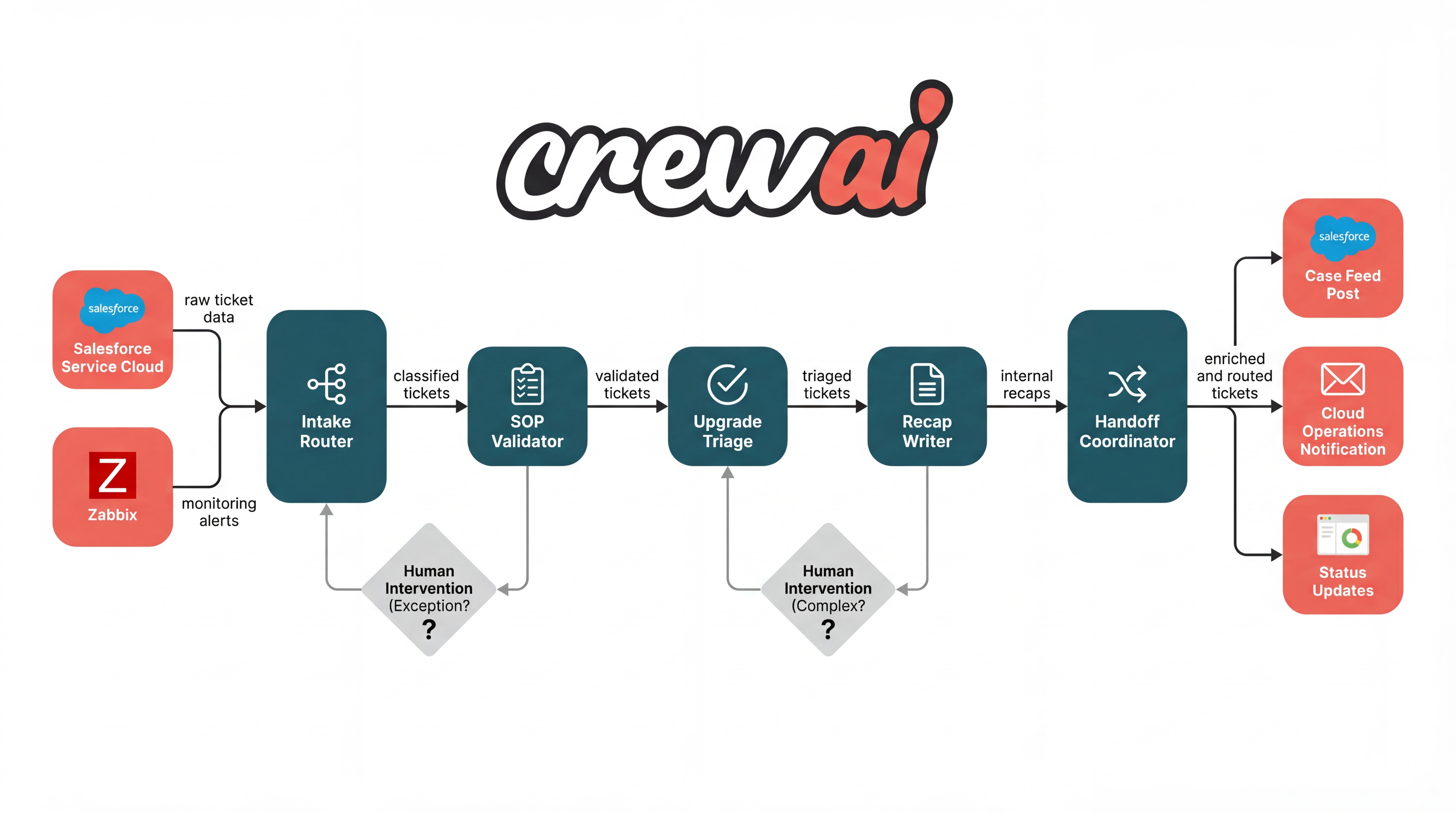
CrewAI’s agentic approach uses a five-agent workflow to untangle the ticket triage triangle. Each agent has a targeted task, automating ticket validation, enrichment, and handoff without human intervention on routine cases.
- Intake Router Agent pulls ticket data from Salesforce Service Cloud and monitoring alerts like Zabbix, classifying each ticket’s event and case type immediately on receipt.
- SOP Validator Agent runs a checklist against standard operating procedures, ensuring required fields are present and flagging incomplete or malformed tickets for correction.
- Upgrade Triage Agent verifies instance and software version to determine if escalation or an upgrade is needed, injecting domain logic into triage decisions.
- Recap Writer Agent drafts clear, consistent internal recaps and notes, keeping the support team and stakeholders updated automatically.
- Handoff Coordinator Agent routes the validated ticket to Cloud Operations or relevant escalation queues via Salesforce and email, updates ticket statuses, and logs all actions in the CRM.
This agentic architecture creates a step-by-step flow: tickets enter, get validated and enhanced, and exit ready for specialists,no loose ends, manual fixes, or blind spots.
Hard Metrics Prove the Impact
Before CrewAI’s multi-agent workflow, manual triage delayed SLA targets and slowed resolution. Handling 15,000+ alert tickets was error-prone and exhausting.
After deployment:
- All 15,000+ alert tickets are fully automated at Level 1 triage, meeting completeness, routing, and communication standards without human touch on routine cases.
- SLA adherence is consistent, hitting a 45-minute contract first response target, with an average first response steady at 20 minutes.
- The system scales smoothly to 20,000 annual tickets without adding headcount.
- Cloud Operations specialists focus on deeper issues and strategic improvements, freed from triage grunt work.
- Ticket status updates and recaps generate in real time, closing eventing gaps that hurt transparency.
Why This Matters for Enterprise Cloud Support
This case exposes a universal bottleneck: complex high-volume ticket triage can’t rely on brittle automation or manual work. A fully agentic, integrated workflow with guardrails,covering classification, validation, triage, enrichment, and routing,unlocks consistent SLA compliance and scalability.
CrewAI’s architecture extends beyond SaaS to telecom NOCs, managed cloud services, financial ops, healthcare IT incident intake, and e-commerce support. Any high-volume workflow benefits from crews, flows, agents, and SOP-based guardrails.
Rule of Thumb: Fix the Ticket Triage Triangle with Agentic Crews
The gap in scaling support isn’t AI itself, it’s the automation’s architecture. Rigidity fails and partial fixes stall. Only purpose-built agents orchestrated end-to-end deliver reliable, auditable, scalable workflows.
Want to automate your cloud support triage like this? Start with CrewAI’s documentation and see how agentic AI crews can turn bottlenecks into breakthroughs.
Comments ()