
How a Global CPG Automates Supply Chain Demand Forecasting with Agentic AI
Discover how CPG supply chains use agentic AI to automate demand forecasting, boosting accuracy and speed while cutting manual effort.
Excel-Built Forecasts Stall Supply Chains
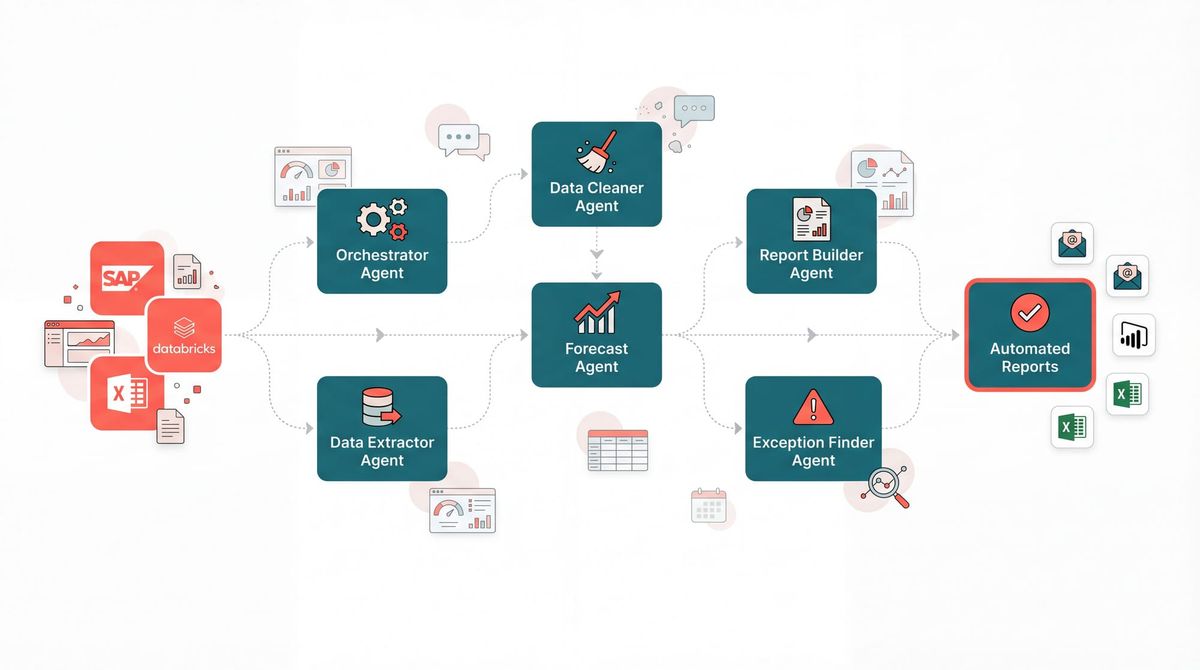
In a leading global beverage company, weekly demand forecasting felt like a spreadsheet battlefield. Demand planners stitched data from SAP, Databricks, and scattered Excel files. The manual cycle was slow, clunky, and error-prone. Forecast accuracy hovered around 70%. A 30% SKU-level error causes costly stockouts or bloated inventory. This problem spans the industry,CPG forecasting errors cost billions, erode margins, and hurt customer satisfaction.
Why Manual Forecasting Fails Supply Chains
This multinational brewer, with dozens of brands, struggled with Excel and siloed data. The fractured picture stifled supply chain agility. Forecasting was guesswork masked as science, with 25-35% errors annually. Global inventory distortion costs reached $1.73 trillion in retail. Traditional automation methods, bots and rule engines, collapsed under multi-source complexity and failed to handle exceptions. Concerns about data privacy and workflow disruption slowed adoption.
Agentic AI Cuts Forecasting to a Crew of Six
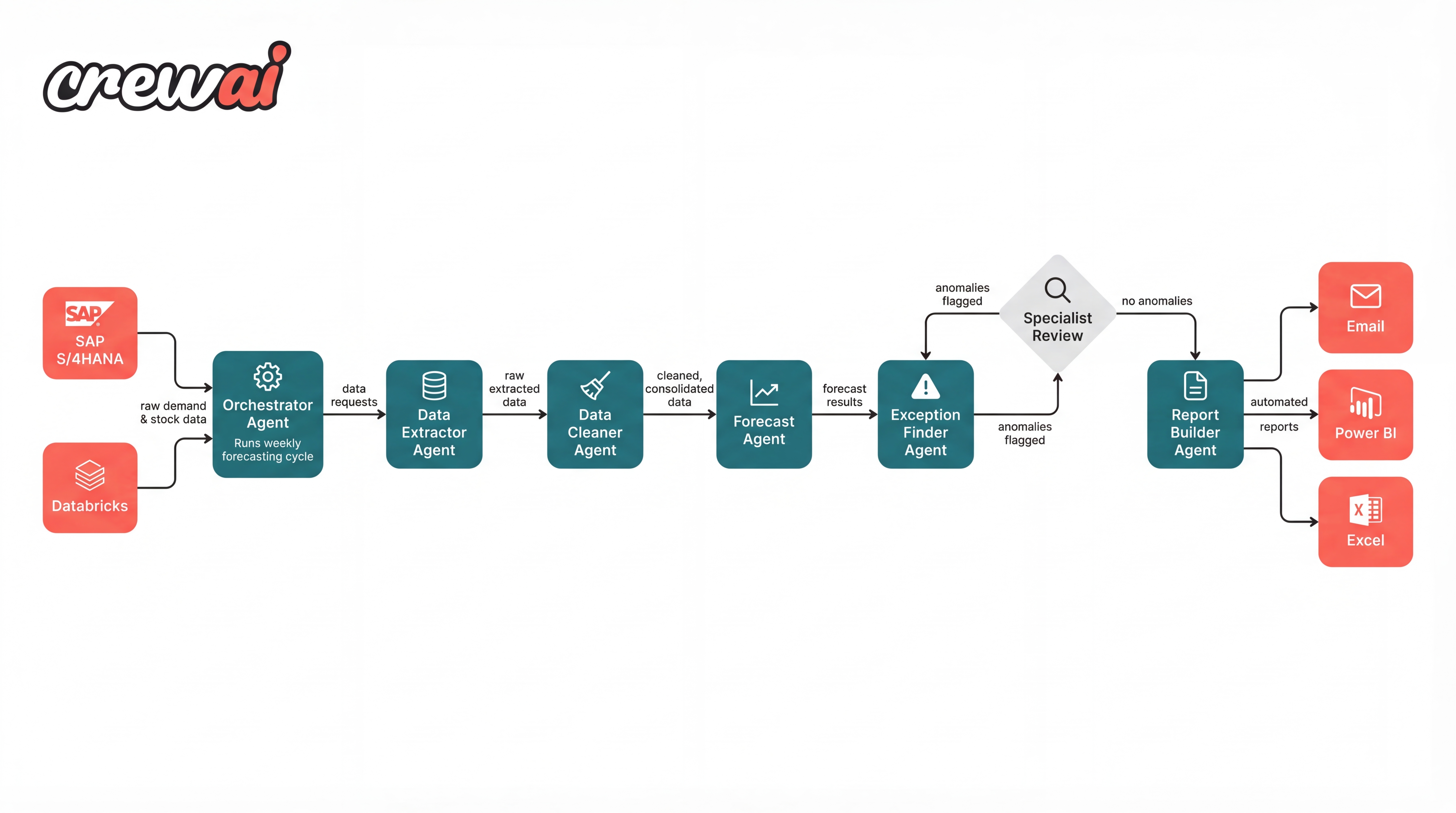
CrewAI rebuilt the weekly forecasting cycle with six specialized AI agents, creating an autonomous, sequenced workflow:
- Orchestrator Agent: Runs the entire weekly forecasting cycle without human trigger.
- Data Extractor Agent: Connects to SAP S/4HANA and Databricks for fresh demand and stock data, removing manual downloads.
- Data Cleaner Agent: Consolidates multiple sources, removes duplicates and errors for clean input.
- Forecast Agent: Runs SKU-level demand models producing granular, accurate predictions.
- Exception Finder Agent: Spots anomalies in stock and purchase orders, flags for human review.
- Report Builder Agent: Assembles forecasts and exception reports, sending automatically via email, Power BI, and Excel.
The agents follow a strict sequence, integrate with enterprise tools, and eliminate manual friction. Specialists intervene only for exceptions, cutting routine work from hours to minutes.
Cutting Weeks to Minutes: The Impact
Before CrewAI, forecasting took a full week of manual curation, validation, and review. Five analysts spent 40 hours weekly collating and cleaning data. Deploying forecasting improvements took about a month.
After CrewAI’s six-agent automation, deployment dropped to two weeks, achieving about 90% automation. Tasks that used to take analysts days vanished. Now the system runs autonomously and delivers insights in minutes. Code and model updates go live within 30 minutes, enabling rapid iteration.
Why This Matters Across Supply Chains
All complex supply chains battle fractured data and manual bottlenecks. Traditional RPA and rule-based tools can’t keep pace with evolving demands, exceptions, and integrations.
Agentic AI treats automation as a crew of specialized agents,each executes a vital step while sharing intelligence and accountability. This design speeds cycles, improves quality, and cuts forecasting risks.
Result: more responsive supply chains, tighter inventory control, and cost reduction. Manufacturers, retailers, and pharmaceuticals can all scale this approach, turning data chaos into coordinated action.
The Bottom Line
The real bottleneck isn’t data or intelligence,it’s the architecture of supply chain processes. Agentic AI crews replace slow manual cycles with end-to-end autonomous workflows that deliver speed, scale, and accuracy legacy tools can’t match.
Explore how CrewAI can redesign your forecasting workflows,the difference lies in the agents, the flows, and the orchestration.
Comments ()