
How Enterprise AI SaaS Closes Adoption Gaps with Multi-Agent Crews
Enterprise AI SaaS automates customer enablement with a 5-agent workflow to close adoption gaps, reduce churn, and scale training across industries
The Silent Adoption Crisis
Imagine spending millions building an AI platform while customers barely use 1-2 features. Revenue slowly declines as usage and consumption sputter. This is a reality for some enterprise AI providers struggling with customer enablement at scale.
Customer enablement and training is broken. Customers are overwhelmed, frontline enablement teams are stretched thin, and churn creeps in. Six-month adoption runways drag on, draining ROI. The “leaky bucket” is a hard-dollar loss happening every week in enterprise SaaS.
More Training Is the Wrong Answer
The forward deployed engineer (FDE) team can’t scale fast enough. They manage only a handful of active use cases per account. High churn rates—6-11% annually—stem from not being able to meet customers where they are resulting in low feature adoption and poor proactive risk triage.
Manual efforts are reactive and fragmented. Traditional automation like RPA or static or hard coded rules engines break under complexity and variation. Outsourcing adds cost and lacks real-time insight into customer signals buried in CRM, support tickets, and emails.
The True Bottleneck: Bandwidth and Context
Durable SaaS adoption is not an intelligence problem; it’s architecture. How do you orchestrate workflows that understand and respond to each customer’s health? How do you automate training at scale without losing context?
The enterprise AI provider cracked this with CrewAI’s agentic automation platform, using a 5-agent workflow architecture that closes adoption gaps by automating customer enablement end-to-end.
Meet the 5-Agent Workflow Crew
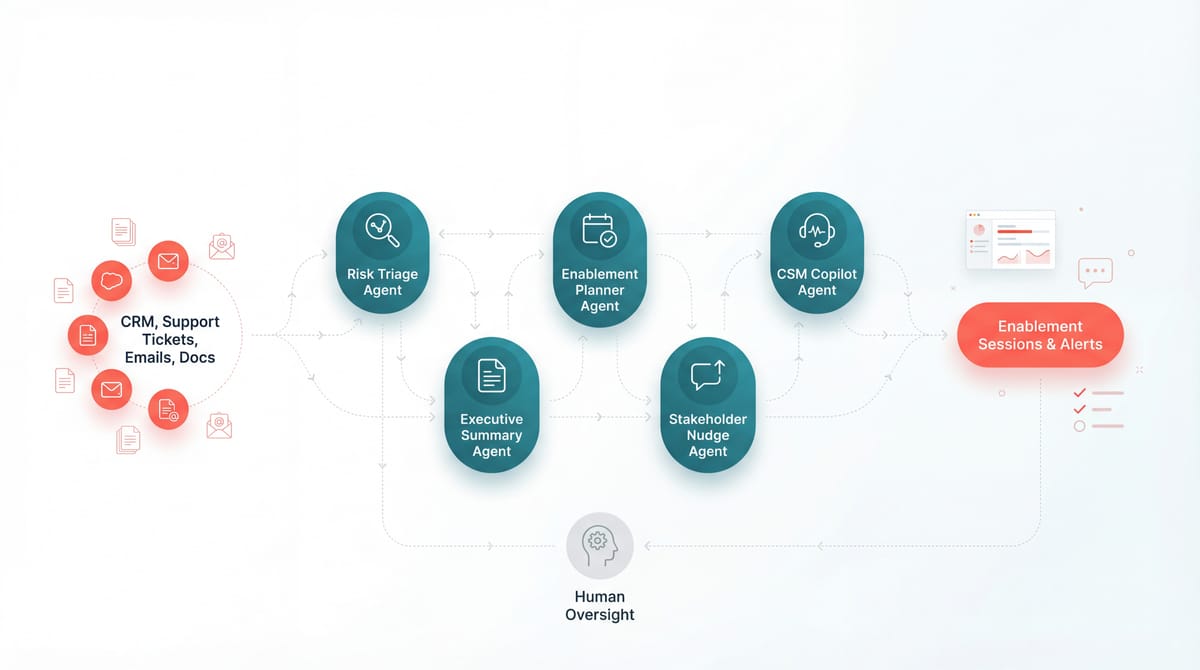
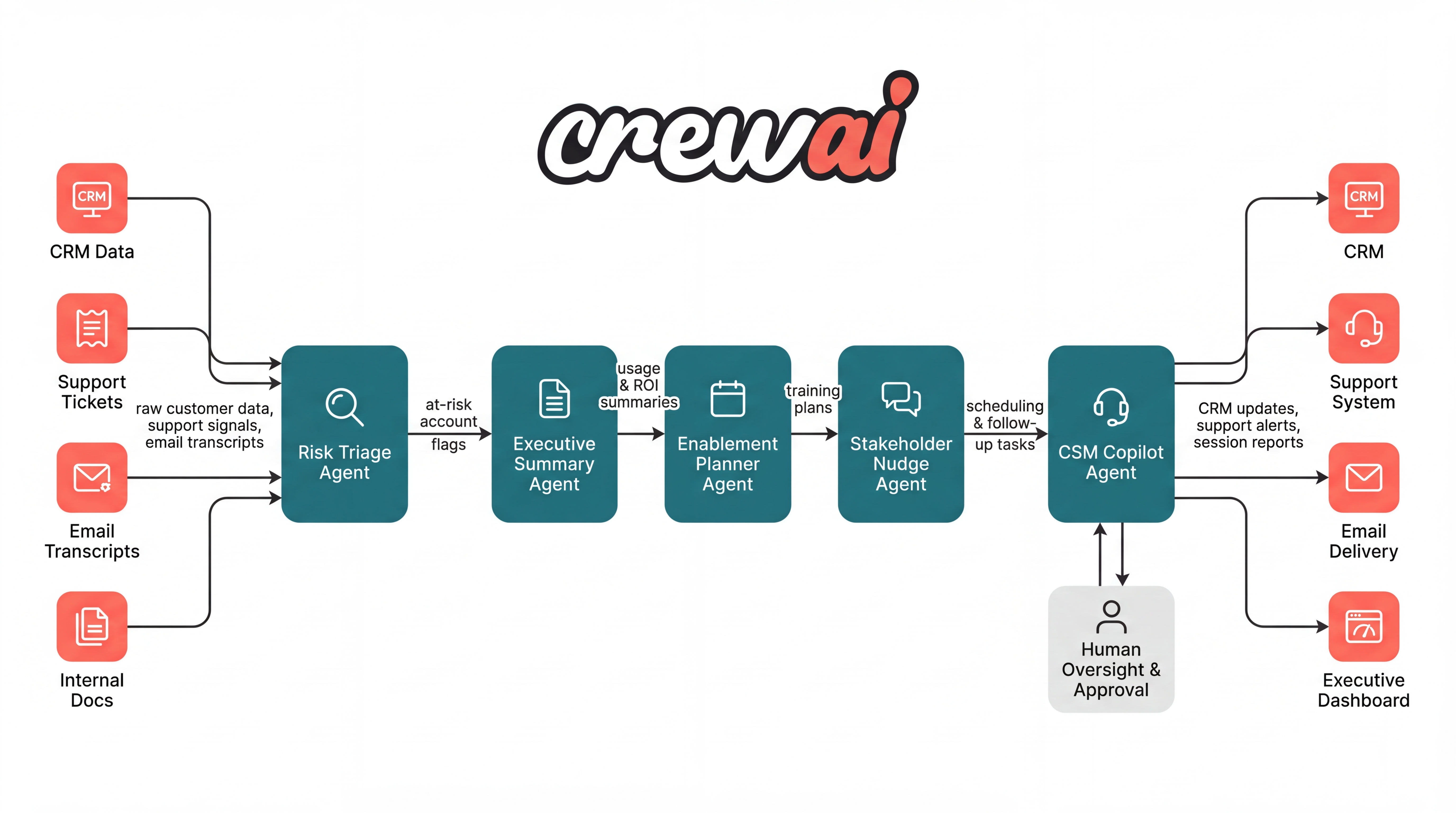
This isn’t blind AI hallucination. It’s a crew of agents, each laser-focused on a distinct, interlocking task, working together seamlessly:
- Risk Triage Agent: Front door that pulls data from CRM, support tickets, emails, and docs, flagging accounts with early signs of churn. It sifts millions of data points to find who needs attention now.
- Executive Summary Agent: Synthesizes usage stats and ROI into briefs leadership acts on immediately.
- Enablement Planner Agent: Crafts bespoke training plans tailored to each customer’s risks and adoption gaps—no cookie-cutter solutions.
- Stakeholder Nudge Agent: Automates scheduling and follow-ups, driving alignment without manual firefighting.
- Customer Success Manager (CSM) Copilot Agent: Runs enablement sessions, updates CRM in real-time, and alerts support teams on emerging issues.
Together, these agents form a continuous feedback loop, transforming multiple data streams into a tightly orchestrated enablement machine—scaling far beyond human limits.
Before & After: From Reactive to Proactive
Before: Manual teams juggling dozens of accounts, struggling to cover 1-2 use cases per smaller client, chasing churn signals weeks or months late. Risk windows stretched out beyond six months.
After: The multi-agent system runs 7,000 to 10,000 workflows weekly—about 500,000 annually—identifying risks, crafting training plans, and driving engagement proactively. Customers expand beyond 1-2 use cases, and teams respond within weeks, cutting the risk runway to six months.
What took 3-4 full-time people weeks to diagnose now runs automatically, at scale, with precision and context.
Why This Matters Across Industries
This reveals a universal SaaS adoption problem—complex platforms demand smart onboarding and ongoing education. It’s not about adding more people to training. It’s about designing AI-powered workflows that augment humans, not replace them.
Industries from IT services and manufacturing to healthcare and financial services face bandwidth-strapped teams trying to scale deployment and cut churn risk. CrewAI’s agentic approach offers a blueprint: compose specialized agents into crews that act in concert to automate nuanced workflows.
This isn’t incremental improvement. It’s foundational: automated enablement workflows delivering tailored, timely interactions grounded in real data, with humans guiding and amplifying the process.
Cut the Adoption Bottleneck with Orchestration
The bottleneck isn’t intelligence—it’s orchestrating it. CrewAI shows how multi-agent crews automate customer enablement at scale, cutting churn risk and unlocking deeper platform value.
Ready to transform your enablement engine? Explore CrewAI’s docs and platform to build your own orchestration workflows.
Comments ()